The first time my borewell pump started clicking on and off every few seconds while I was just rinsing a plate, I thought the motor was dying. It wasn’t. My pressure tank had lost its air charge. Understanding how a pressure tank works saved me from a needless pump replacement that day, and it can save you a lot of grief too.
I’m Arjun, and I’ve run my own borewell, pump, and overhead-tank setup for more than 15 years. In this beginner primer I’ll explain, in plain language, what that steel or bladder tank next to your pump actually does, why your motor genuinely needs one, and how the air inside it keeps your taps steady. For the full picture of the setup this tank belongs to, see our complete owner’s guide to home water pumps and pressure systems.
Key Takeaways
- A pressure tank stores water under pressure so small draws (a glass of water, a quick hand-wash) don’t force your pump to start.
- Its main job is protecting the motor: it cuts pump starts from dozens per hour down to a handful, which dramatically extends motor life.
- Inside is a cushion of compressed air. Correct pre-charge is usually 2 psi below your pump’s cut-in pressure.
- Most home tanks today are bladder or diaphragm type, holding a “drawdown” of roughly 6-12 litres from a 60-80 litre tank.
- A tank with no air charge (a “waterlogged” tank) makes the pump rapid-cycle, the classic sign something is wrong.
What does a pressure tank do?

A pressure tank is a small reservoir that holds a few litres of water while keeping it squeezed under pressure by a cushion of air. That squeezed water is what actually comes out of your tap the instant you open it, not water pumped fresh from the well every single time.
Without a tank, your pump would have to switch on the moment you cracked a tap and switch off when you closed it. Open the tap for two seconds to rinse a spoon, and the motor fires up for two seconds. Do that thirty times an hour and you’re punishing the motor, the wiring, and the pressure switch contacts. The tank absorbs those small demands so the pump can rest.
Think of it like the difference between a bucket brigade and a water balloon. The pump fills the balloon (tank) when pressure drops; the balloon then feeds your taps smoothly until it needs a top-up. This is the heart of pressure tank basics, and once it clicks, everything else about your system makes more sense.
How a pressure tank works: the air-and-water balancing act
Here’s the mechanism, step by step, so you can picture what’s happening inside:
- The tank is sealed and pre-charged with air to a set pressure before any water enters.
- When you use water and system pressure drops to the cut-in point (say 30 psi), the pressure switch tells the pump to start.
- The pump pushes water into the tank, compressing the air cushion further as the water level rises.
- When pressure reaches the cut-out point (say 50 psi), the switch stops the pump. The tank is now “charged” and full of pressurised water.
- As you draw water, the compressed air pushes it back out to your taps, and pressure slowly falls again toward cut-in, then the cycle repeats.
The amount of water delivered between cut-out and cut-in is called drawdown. That’s the useful buffer. A bigger tank has more drawdown, so the pump starts less often. This whole dance is governed by your pressure switch, if your cut-in and cut-out feel wrong, our guide on how to set a pressure switch and adjust cut-in and cut-out walks through the adjustment.
Bladder tank explained (vs. plain air-over-water)
Older tanks were just a steel shell where air sat directly on top of the water. The problem: air slowly dissolves into water and escapes out the taps, so the tank goes “waterlogged” and needs regular re-charging with a bicycle pump.
Modern tanks fix this with a physical barrier. In a bladder tank, water fills a rubber balloon inside the shell while air stays sealed in the surrounding space. A diaphragm tank uses a fixed rubber sheet dividing air from water. Either way, air and water never touch, so the charge lasts for years instead of weeks.
| Tank type | How it separates air & water | Maintenance | Best for |
|---|---|---|---|
| Plain steel (air-over-water) | None, air sits on water | Re-charge air often; drains & refills | Old installs, cheap replacements |
| Diaphragm | Fixed rubber sheet | Low, check charge yearly | Most home systems |
| Bladder (replaceable) | Rubber balloon holds water | Low; bladder can be swapped | Larger or harder-working systems |
Why your pump needs one (and what happens without it)
The single biggest reason for a pressure tank is motor protection. Every time a motor starts, it draws a big inrush of current and heats up. Motors are rated for a limited number of starts per hour. Blow past that and the windings cook.
A rightly-sized tank keeps starts down to roughly 6-10 per hour under normal use instead of 30, 40, or more. On my own borewell, when my old tank quietly waterlogged, the pump was cycling every 8-10 seconds while showering. The motor got hot enough to smell. Fitting a fresh diaphragm tank dropped it to one calm cycle every couple of minutes.
A pressure tank also does three quieter but real jobs:
- Steady pressure at the tap, no big pressure swing every time the pump kicks in and out.
- Absorbs water hammer, that bang in the pipes when a tap or valve slams shut.
- Instant delivery, for small draws the tank answers alone, so you’re not waiting on the pump to spin up.
Skip the tank and you get short pump life, jumpy pressure, noisy pipes, and a pressure switch that burns out its contacts from constant clicking. That rapid on-off is also a red flag for other faults, if yours won’t hold prime between cycles, see how to prime a water pump when it loses prime.
Tip from experience: The fastest way to test a tank is to tap the side with a spanner. The top (air) section rings hollow; the bottom (water) section sounds dull and solid. If the whole tank sounds full and dull, your air charge is gone, that’s a waterlogged tank, and the pump will rapid-cycle until you re-charge or replace it.
How much air should be in a pressure tank?
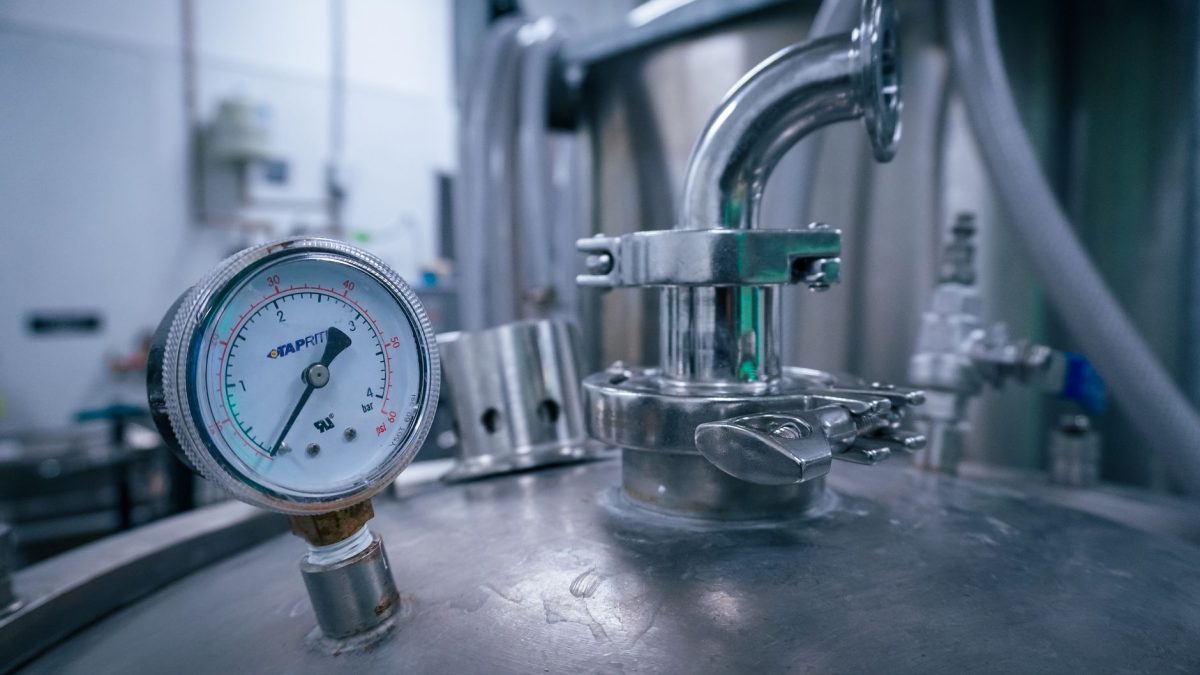
This is the number people get wrong most often, so let’s be precise about the rule. The tank’s air pre-charge should be set to 2 psi below your pump’s cut-in pressure, measured when the tank is empty of water.
- Cut-in 20 psi → pre-charge to 18 psi.
- Cut-in 30 psi → pre-charge to 28 psi.
- Cut-in 40 psi → pre-charge to 38 psi.
Set it too high and there’s little room for water, you get almost no drawdown and near-constant cycling. Set it too low and pressure sags at the tap toward the end of each draw. The 2-psi rule keeps a small water buffer available right down to cut-in.
Checking and setting the pre-charge
- Switch off the pump at the mains and open a nearby tap to drain the tank’s water and release system pressure.
- Find the air valve on top of the tank, it looks exactly like a car tyre valve (Schrader).
- Press a tyre gauge onto it and read the pressure. A little water spitting out means the bladder or diaphragm has failed.
- Add air with a bicycle or foot pump, or bleed some off, until you hit 2 psi below cut-in.
- Cap the valve, restore power, and let the system pressurise. Watch that cycling has calmed down.
Check this once a year, or any time you notice rapid cycling. It takes ten minutes and costs nothing but a tyre gauge.
Do I need a pressure tank with my pump?
Almost always, yes, but it depends on how your system is plumbed:
- Pump feeding taps directly (pressure system): You need a pressure tank. Without it the pump can’t behave.
- Pump only filling an overhead tank: Here the overhead tank and a float switch do the buffering, so a pressure tank isn’t required for that leg, though many Indian homes add a small booster pump with its own tank for the downstairs pressure.
- Modern constant-pressure (VFD) pump: These vary motor speed to hold pressure and often need only a tiny tank, or none, but they cost more up front.
A rough sizing guide: match tank drawdown to your pump’s flow so the motor runs at least a minute per cycle. In my experience a good home diaphragm tank runs roughly ₹3,000, ₹8,000 depending on size and brand, and a replacement bladder alone is a fraction of that. Balancing tank size against running cost matters, our breakdown of water pump running cost and efficiency shows why fewer, longer cycles save both the motor and your electricity bill.
One safety note: if your well water feeds drinking taps, a pressure tank does nothing to clean it. Test your water with a certified lab and treat it separately. For general guidance on private well water, India’s Central Ground Water Board and the US EPA private wells resource are solid, non-commercial starting points.
Frequently Asked Questions
What is the point of a pressure tank?
Its main point is to store water under pressure so your pump doesn’t start for every small draw. That protects the motor from frequent, damaging starts, holds steady pressure at your taps, absorbs water hammer, and lets small demands be met instantly without waiting for the pump.
How much air should be in a pressure tank?
Set the air pre-charge to 2 psi below your pump’s cut-in pressure, measured with the tank drained of water. So a 30 psi cut-in means an 18-28 psi range: pre-charge to 28 psi. Too high starves drawdown; too low lets tap pressure sag late in each draw.
Do I need a pressure tank with my pump?
If the pump feeds your taps directly, yes, it’s essential to prevent rapid cycling. If the pump only fills an overhead tank, that tank buffers instead, so a pressure tank isn’t needed for that leg. Constant-pressure VFD pumps need only a small tank or none.
How do I know if my pressure tank is bad?
The classic sign is rapid pump cycling, clicking on and off every few seconds during light use. Tap the tank: if it sounds uniformly full and dull with no hollow air section on top, the charge is gone. Water spitting from the air valve means the bladder or diaphragm has failed and the tank needs replacing.
How long does a pressure tank last?
A quality bladder or diaphragm tank often lasts 8-15 years with a yearly air-charge check. Plain steel air-over-water tanks fail sooner because the charge escapes constantly. Hard water, corrosion, and running the pre-charge wrong all shorten life. Swapping a replaceable bladder can extend a good shell further.
Putting it together
A pressure tank is a small, cheap part doing a big job: it stands between your motor and an early grave. Get its air charge right, 2 psi below cut-in, and it quietly delivers steady, instant water while your pump loafs along at a handful of starts an hour. Ignore it, and rapid cycling will chew through your motor and switch.
If you’re piecing together how your whole setup fits, pump, switch, tank, and pipes, start with our complete owner’s guide to home water pumps and pressure systems, or browse more in the Pumps & Pressure Systems category. Ten minutes with a tyre gauge today can save you a pump next year.